Re: Status of SMR with BTRFS
From: Henk Slager <hidden>
Date: 2016-07-17 20:48:40
quoted
quoted
It's a Seagate Expansion Desktop 5TB (USB3). It is probably a
ST5000DM000.
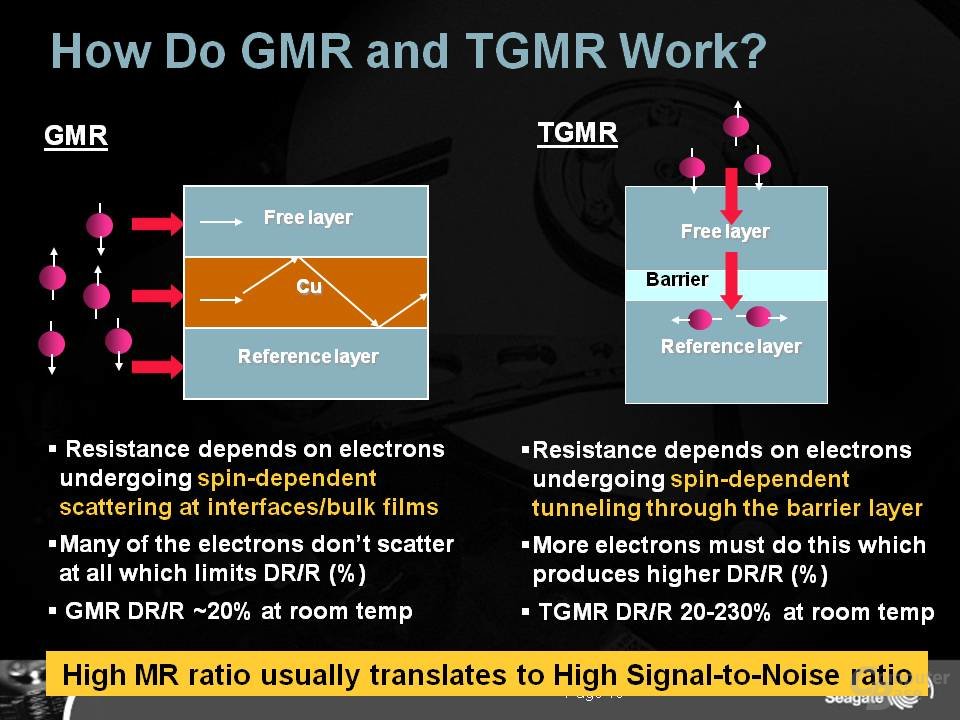
this is TGMR not SMR disk: http://www.seagate.com/www-content/product-content/desktop-hdd-fam/en-us/docs/100743772a.pdf So it still confirms to standard record strategy ...I am not convinced. I had not heared TGMR before. But I find TGMR as a technology for the head. https://pics.computerbase.de/4/0/3/4/4/29-1080.455720475.jpg In any case: the drive behaves like a SMR drive: I ran a benchmark on it with up to 200MB/s. When copying a file onto the drive in parallel the rate in the benchmark dropped to 7MB/s, while that particular file was copied at 40MB/s.
It is very well possible that for a normal drive of 4TB or so you get
this kind of behaviour. Suppose you have 2 tasks, 1 writing in with 4k
blocksize to a 1G file at the beginning of the disk and the 2nd with
4k blocksize to a 1G file at the end of the disk. At the beginning you
get sustained ~150MB/s, at the end ~75MB/s. Between every 4k write (or
read) you move the head(s), so ~4ms lost.

I was wondering how big the zones etc are and hopefully this is still true:
http://blog.schmorp.de/data/smr/fast15-paper-aghayev.pdf
https://github.com/kdave/drafts/blob/master/btrfs/smr-mode.txt
And this does sound like improvements to BTRFS can be done for SMR in a
generic, not vendor/device specific manner.
Maybe have a look at recent patches from Hannes R from SUSE (to 4.7
kernel AFAIK) and see what will be possible with Btrfs once this
'zone-handling' is all working on the lower layers. Currently, there
is nothing special in Btrfs for SMR drives in recent kernels, but in
my experience it works, if you keep device-managed SMR
characteristics/limitations in mind. Maybe like a tape-archive or
dvd-burner.