Re: [PATCH v4 00/14] Add kdbus implementation
From: Andy Lutomirski <hidden>
Date: 2015-03-18 18:24:41
Also in:
lkml
On Wed, Mar 18, 2015 at 6:54 AM, David Herrmann [off-list ref] wrote:
Hi

On Tue, Mar 17, 2015 at 8:24 PM, Andy Lutomirski [off-list ref] wrote:
[...]
quoted
Can anyone comment on how fast it actually is.  I'm curious
about:

 - The time it takes to do the ioctl to send a message

 - The time it takes to receive a message (poll + whatever ioctls)
I'm not sure I can gather useful absolute data here. This highly depends on how you call it, how often you call it, what payloads you pass, what machine you're on.. you know all that. So here's a flamegraph for you (which I use for comparisons to UDS): http://people.freedesktop.org/~dvdhrm/kdbus_8kb.svg This program sends unicast messages on kdbus and UDS, exactly the same number of times with the same 8kb payload. No parsing, no marshaling is done, just plain message passing. The interesting spikes are sys_read(), sys_write() and the 3 kdbus sys_ioctl(). Everything else should be ignored. sys_read() and sys_ioctl(KDBUS_CMD_RECV) are about the same. But note that we don't copy any payload in RECV, so it scales O(1) compared to message-size. sys_write() is about 3x faster than sys_ioctl(KDBUS_CMD_WRITE).
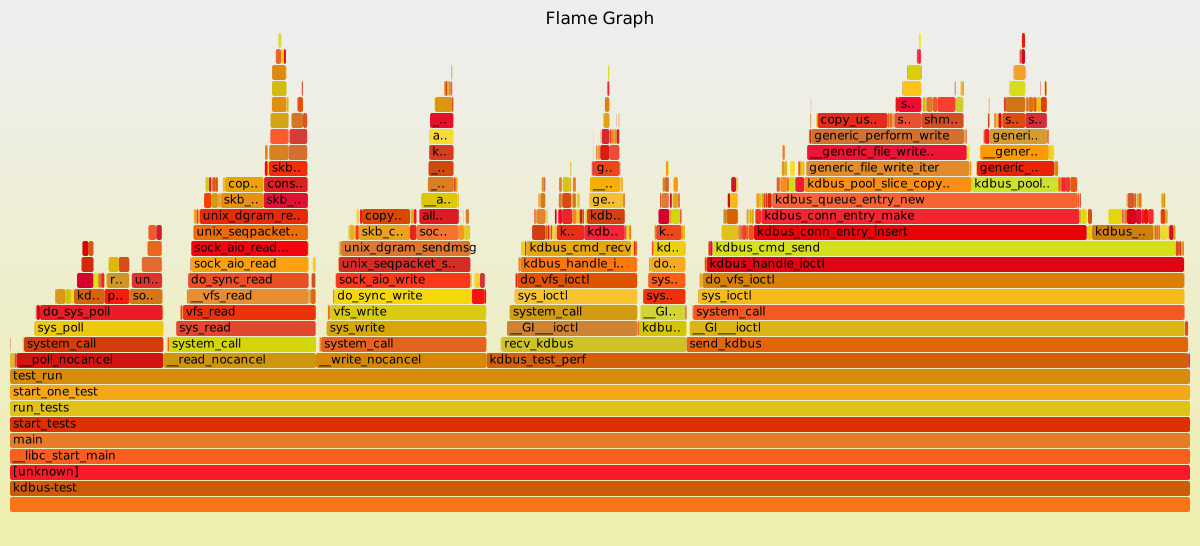
Is that factor of 3 for 8 kb payloads?  If so, I expect it's a factor
of much worse than 3 for small payloads.
I see lots of room for improvement in both RECV and SEND. Caching the
namespaces on a connection, would get rid of
kdbus_queue_entry_install() in RECV, thus speeding it up by ~30%. In
SEND, we could merge the kvec and iovec copying, to avoid calling
shmem_begin_write() twice. We should also stop allocating management
structures that are not used (like for metadata, if no metadata is
transmitted). We should use stack-space for small ioctl objects,
instead of memdup_user(). And so on.. Oh, and locking can be reduced.
We haven't even looked at rcu, yet (though that's mostly interesting
for policy and broadcasts, not unicasts).
quoted
 - The time it takes to transfer a memfd (I don't care about how long
it takes to create or map a memfd -- that's exactly the same between
kdbus and any other memfds user, I imagine)
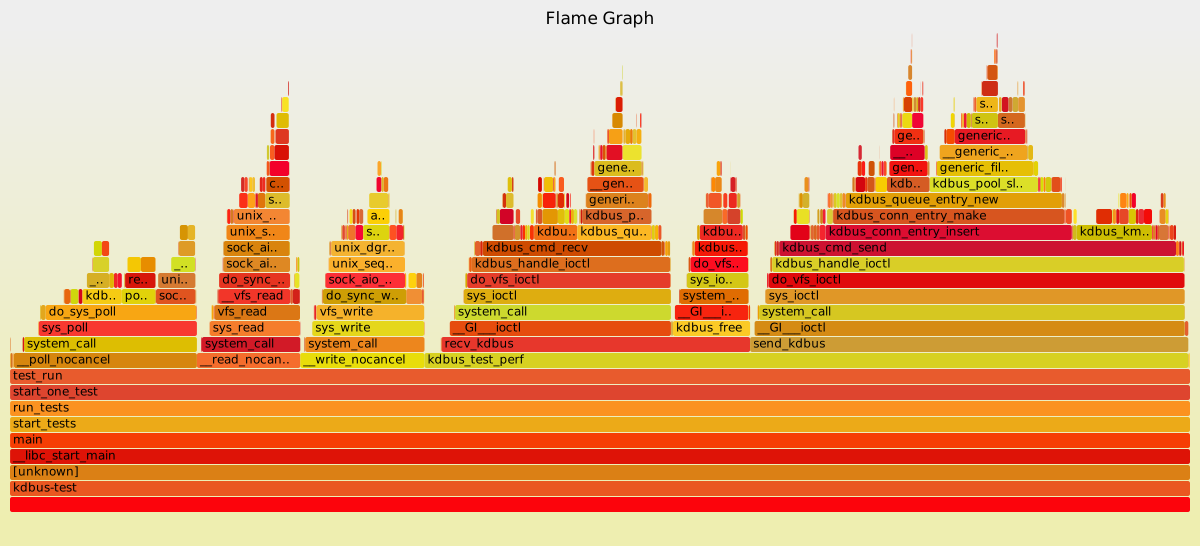
The time to transmit a memfd is the same as to transmit a 64-byte payload. Ok, you also get to install the fd into the fd-table, but that's true regardless of the transport. Here's a graph for 64byte transfers (otherwise, same as above): http://people.freedesktop.org/~dvdhrm/kdbus_64b.svgquoted
- The time it takes to connectNo idea, never measured it. Why is it of interest?
Gah, sorry, bad terminology.  I mean the time it takes to send a
message to a receiver that you haven't sent to before.

(The kdbus terminology is weird.  You don't send to "endpoints", you
don't "connect" to other participants, and it's not even clear to me
what a participant in the bus is called.)
quoted
I'm also interested in whether the current design is actually amenable
to good performance.  I'm told that it is, but ISTM there's a lot of
heavyweight stuff going on with each send operation that will be hard
to remove.
I disagree. What heavyweight stuff is going on?
At least metadata generation, metadata free, and policy db checks seem
expensive.  It could be worth running a bunch of copies of your
benchmark on different cores and seeing how it scales.

--Andy