Re: [PATCH v5] doc: add an explanation of Git's data model
From: Julia Evans <hidden>
Date: 2025-11-05 16:27:03
On Tue, Nov 4, 2025, at 10:21 PM, Ben Knoble wrote:
quoted
Le 4 nov. 2025 à 19:02, Julia Evans [off-list ref] a écrit : quoted
On Tue, Nov 4, 2025, at 6:45 PM, Junio C Hamano wrote:
"Julia Evans" [off-list ref] writes:
quoted
I do not see the point of implying that the commit ID is not "special", or that
it's only one of many ways to find a commit because to me it seems very special,
since there is no way I know of to retrieve a commit that doesn't ultimately
end up using the commit ID at some point. (though that ID might not be encoded
in hexadecimal)
That is not what I am trying to say. The hexadecimal name is the most neutral way to refer to a commit object, and in that sense it is special. It is the way ref subsystem uses to record the name of objects, and that makes it special enough. But that does not mean that the name _is_ the object. The hexadecimal name is a way you use to name the object, but is not the object itself, and the special-ness of that name does not change it.Okay. I still do not understand at all why this is so important to you (for the reasons I mentioned before) but I'll see if there's anything I can do.Perhaps one way to look at is, what diagram would I draw given different textual explanations? The diagram we _want_ folks to draw (?) is the one where a branch points at a commit [a circle, perhaps], which points to a tree [triangle] and recursively blobs [squares], like I’ve seen Stolee draw for GitHub blogs. We might also want folks to label the arrows with names, or not. One way to interpret the “branch refers to a commit ID” might be to draw a diagram where the branch points to an ID label, and to find the circle you have to separately consult a different part of the diagram.
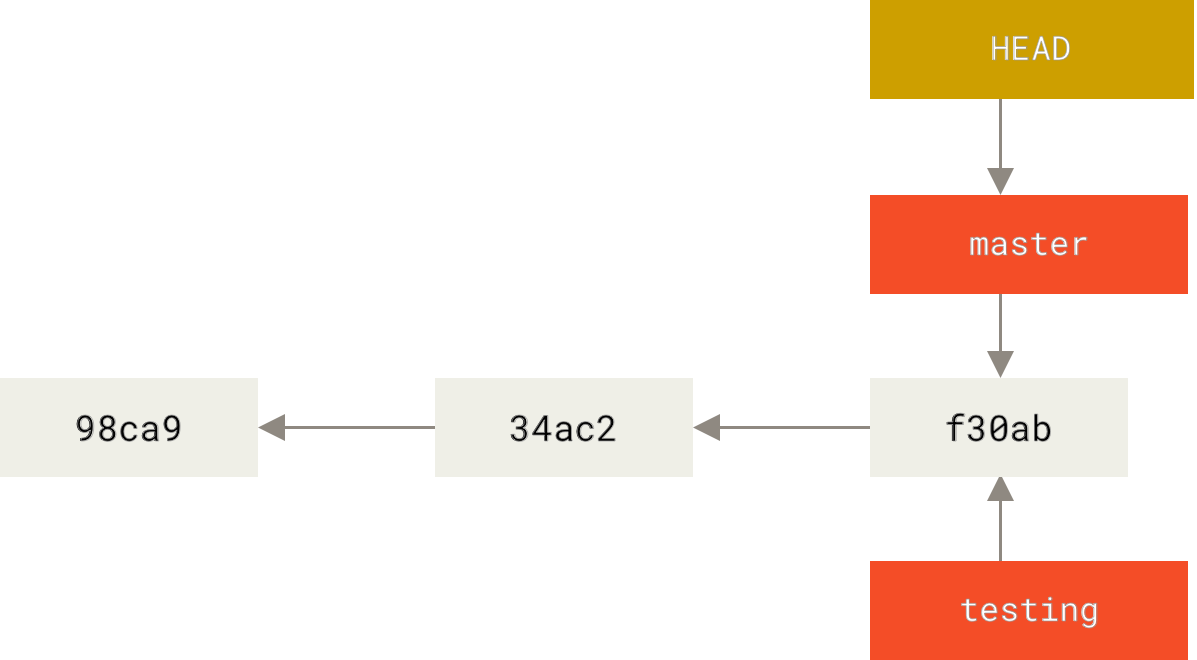
Yes, the most common type of Git diagram I see is something like this:
https://git-scm.com/book/en/v2/images/head-to-master.png
which only includes references, commits, and HEAD.

That's the diagram I have in mind when writing this text, and I think it's
a useful and accurate diagram to keep in mind, and it's one that you see
very often when using Git tools, including in `git log --graph`. (it's not
a _complete_ diagram of every type of object, but diagrams do not need to be
complete to be accurate)

I personally would not use a graph diagram to explain how commits relate to
trees and blobs (normally I use `git cat-file -p` instead, like I did in this
`gitdatamodel` document. You can see this comic for a "visual" example of how
I've approached discussing trees and blobs in the past with `git cat-file -p`
https://wizardzines.com/comics/explore-a-commit/).
Both seem useful to me, though as the former has fewer moving pieces
might be better for the model this document describes? I dunno.